
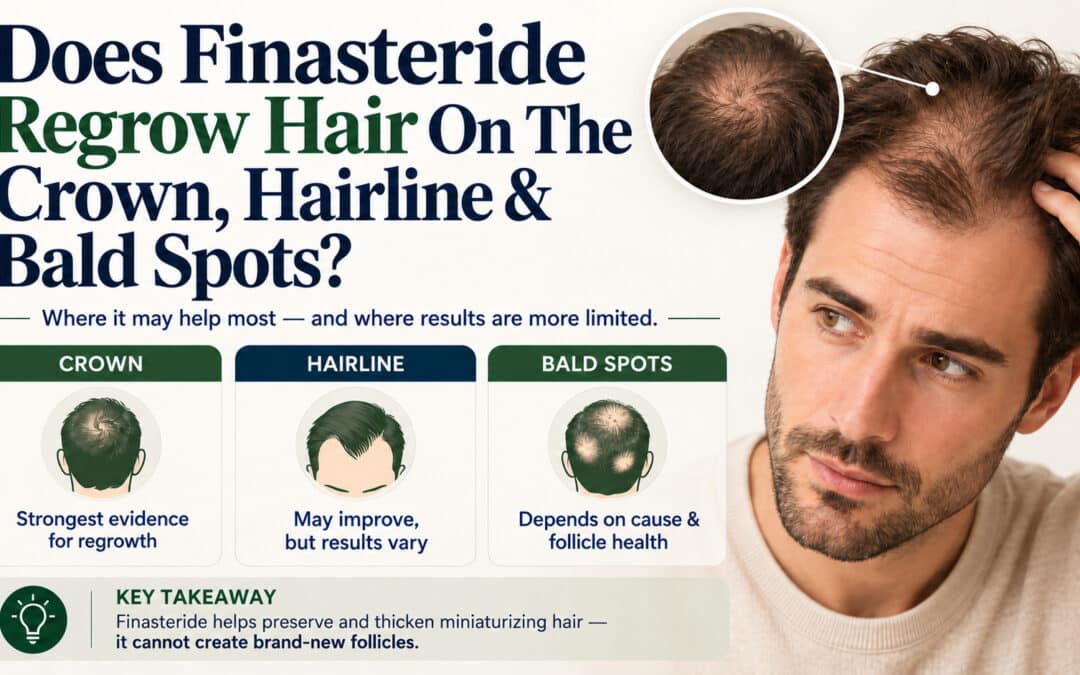
Does finasteride regrow hair, or does it simply prevent further loss? If you have heard about Propecia and hair regrowth, you may be wondering what changes are possible, where new growth might appear & how long results take. In this guide, we examine the evidence for the crown, hairline and bald spots, along with the limits of treatment and what realistic progress looks like over time.
Does finasteride regrow hair?
Yes, finasteride can regrow some hair in men with androgenetic alopecia, commonly called male pattern hair loss. It can also help preserve existing hair by slowing the process that causes follicles to produce progressively finer strands. However, finasteride regrowth varies from person to person, and a return to your original hair density is not guaranteed.
It is useful to separate three possible outcomes: less ongoing shedding caused by male pattern hair loss, thicker hairs growing from follicles that have become miniaturized, and a visible increase in hair count or coverage. Some people experience all three. Others notice that hair loss stabilizes, even if they do not see dramatic new growth.
A natural follow-up question is how effective is finasteride? Clinical trials provide encouraging evidence for men with male pattern hair loss. In a study involving more than 1,500 men, oral finasteride 1 mg improved hair counts and photographic assessments over one and two years compared with placebo. The results support both slowing further loss and increasing growth, rather than guaranteeing the same outcome for everyone.
You may also wonder: does finasteride thicken hair? It may help miniaturized follicles produce thicker, more visible strands. That can make the scalp look fuller without every improvement representing the appearance of an entirely new hair. Increased density and increased shaft thickness can both matter cosmetically.
Results take time because hair grows in cycles. The prescribing information for oral finasteride notes that at least three months of daily treatment is generally needed before a benefit may be observed. Many patients need six to 12 months to judge visible changes, and some improvements develop further into the second year. There is no reliable separate timeline for crown growth versus hairline growth.
During those months, try to assess progress consistently rather than checking the mirror every day. Photographs taken with the same lighting, angle and hair length can help distinguish genuine changes from fluctuations in styling or appearance. A clinician can also evaluate whether the treatment is stabilizing loss, even when the difference feels subtle.
Some people notice increased shedding during treatment and worry that they are losing progress. A finasteride shedding phase is sometimes reported, but it is not a guaranteed step or proof that the medication is working. Persistent or unusually heavy shedding deserves assessment, particularly if another cause of hair loss may be involved.
Finasteride may help on its own, so taking finasteride without minoxidil does not automatically mean treatment will fail. Minoxidil promotes growth through a different mechanism and is sometimes used alongside finasteride. Whether combining treatments makes sense depends on your pattern of loss, medical history, goals and tolerance of treatment.
Most of the established regrowth evidence discussed here concerns oral finasteride 1 mg in adult men with androgenetic alopecia. Other formulations, including topical finasteride, should not be assumed to deliver exactly the same results at every dose or preparation. Finasteride is also not an appropriate self-treatment for every type of hair loss.
Treatment options can differ between men and women. For example, discussions about spironolactone hair growth are more relevant to some women with female pattern hair loss than to men seeking a routine replacement for finasteride. Diagnosis matters because the underlying cause determines which treatments may be appropriate.
How does finasteride regrow hair?
Finasteride blocks the enzyme 5-alpha-reductase, which converts testosterone into dihydrotestosterone, or DHT. In people genetically susceptible to male pattern hair loss, DHT contributes to follicle miniaturization. Over time, affected follicles may produce shorter, finer hairs, creating the appearance of thinning or recession.
By lowering DHT, finasteride reduces one of the signals driving that miniaturization. Understanding how to block DHT can help explain why targeting this hormone matters in male pattern hair loss. Follicles that remain capable of producing hair may begin growing stronger strands or sustain growth for longer. That explains how the medication can improve coverage, but also why outcomes depend partly on the condition of the follicles when treatment begins.
Finasteride does not manufacture new follicles or move hair from one part of the scalp to another. It works with follicles that already exist and retain the ability to respond. This distinction is especially important when considering long-established bald areas, where visible restoration may be much harder to achieve.
Its effects also depend on continued use. The prescribing information advises reassessing benefit over time and notes that stopping treatment generally leads to reversal of the treatment-related effect within about 12 months. Someone seeing stability or regrowth should not assume the gains will remain indefinitely after discontinuing the medication.
Does finasteride regrow hair on crown?
Yes, the crown, also called the vertex, is one of the best-studied areas for finasteride regrowth. Clinical trials of oral finasteride 1 mg found improvements in hair counts in men with thinning at the top and back of the scalp. That makes crown thinning a particularly relevant setting when discussing evidence-backed results.
In two clinical trials, researchers counted hairs in a small, defined circle measuring approximately 5.1 square centimeters on the vertex. At 12 months, the finasteride group had an average of 107 more hairs than the placebo group in that measured area. At 24 months, the difference was 138 hairs. These figures compare treatment groups; they are not the total number of hairs an individual can expect to regrow across the scalp.
The same studies found that untreated participants generally continued losing hair while men taking finasteride showed improved growth measures. Part of the treatment’s value is therefore preventing the crown from becoming noticeably thinner. A modest visible improvement may be meaningful when the alternative would have been continuing loss.
Results are not identical for every person with crown thinning. Someone whose scalp still has many fine, miniaturized hairs may have more visible potential for improvement than someone with a long-standing, extensively bare crown. Hair texture, starting density and the progression of androgenetic alopecia also affect how fuller the area appears.
You do not need to expect a separate, faster crown-specific timeline. Like the rest of the scalp, the crown may take months to show a noticeable response. Comparing photographs every few months is more useful than looking for daily growth, and a clinician can help determine whether limited results warrant reconsidering the treatment plan.
Does finasteride regrow hairline?
Finasteride can improve hair growth in some frontal areas, but its ability to restore a receding hairline is less predictable than its effects on crown thinning. In particular, it is important to distinguish the frontal mid-scalp, where hair may be getting thinner, from the temples and the very front edge of a receded hairline.
Research has shown increased growth in men with anterior mid-scalp thinning. However, US prescribing information states that effectiveness for bitemporal recession has not been established. That means someone hoping to reverse deep temple recession should not assume finasteride will rebuild the hairline they had years earlier.
When researching finasteride frontal hair loss, you may encounter conflicting claims. One source may say it works only on the crown, while another suggests it restores the entire front of the scalp. Neither extreme is a good summary: evidence supports some frontal improvement, but the degree of response in the temple corners remains uncertain.
When thinning is relatively early and fine hairs are still present, maintaining those hairs or improving their thickness may make the frontal region look denser. Where the hairline has moved substantially and the skin appears bare, medication is less likely to create a dramatic change. The duration and extent of miniaturization matter more than a simple yes-or-no answer.
It is equally important not to confuse stabilization with a lack of success. If your hairline stops receding while the rest of your hair retains its density, treatment may be helping protect what remains. Finasteride is just one option when considering how to stop a receding hairline, and the best approach depends on how far the hair loss has progressed. A clinician can compare photographs over time and explain whether medication alone is likely to meet your expectations for the front of the scalp.
Can finasteride regrow hair in bald spots?
Sometimes, but the answer depends on what caused the bald-looking area and whether responsive follicles remain. A thin patch caused by male pattern hair loss is different from a sharply defined bald patch caused by another condition. Finasteride is a treatment for androgenetic alopecia, not a universal remedy for every type of patchy hair loss.
An area can look bald while still containing fine, miniaturized hairs. If those follicles remain viable, reducing DHT may allow some to produce more visible strands. In a long-standing, smooth-looking area with very advanced follicular changes, meaningful regrowth is less likely. Appearance alone cannot confirm whether follicles are still capable of responding.
If bald spots appeared suddenly, are round and sharply bordered, or come with itching, redness, scaling or scarring, arrange an assessment rather than assuming male pattern hair loss. Conditions such as alopecia areata or inflammatory scalp disorders require a different diagnostic approach. Treating the wrong condition may delay appropriate care.
For men with androgenetic alopecia who are not seeing enough improvement, a clinician may discuss medication adjustments or other options. A comparison of finasteride vs dutasteride can help explain why another DHT-reducing medication is sometimes considered, but stronger DHT suppression cannot guarantee regrowth in an area where follicles no longer respond.
There is also no single finasteride alternative for hair loss that works for everyone. Minoxidil, other prescription treatments and hair restoration procedures may have a role depending on the diagnosis. A transplant, for example, redistributes follicles rather than reversing miniaturization through medication.
Before deciding a bald spot is beyond treatment, establish the cause of the loss and what hair remains. Even when complete regrowth is unlikely, the right plan may preserve neighboring hair and improve overall coverage. Realistic goals should consider both the hair already lost and the hair that can still be protected.
Key takeaways on finasteride regrowth
Finasteride can help some men regrow hair, particularly where follicles are miniaturized rather than completely unresponsive. The crown has strong clinical evidence, while frontal mid-scalp improvement is possible and restoration at the temples is less predictable. Preventing further loss can also be an important benefit, even without dramatic visible regrowth.
Allow enough time to assess the outcome. Initial benefits may require three months or more, and changes are often better judged after six to 12 months of consistent treatment. Not everyone reaches the same density, and treatment generally needs to continue for benefits to be maintained. Your pattern of hair loss and medical history should guide expectations.
If you are exploring how to get topical finasteride, start with a medical review of the diagnosis, available formulations and potential risks. If you need a finasteride prescription, a qualified clinician should determine whether the medication is appropriate, explain your options and discuss follow-up.
Finasteride is a prescription medication with potential adverse effects, including sexual dysfunction, depression and suicidal thoughts. Tell your clinician about mood changes or sexual side effects; seek urgent help for suicidal thoughts. Finasteride can also lower PSA blood-test results, so tell anyone interpreting a PSA test that you take it. Oral finasteride 1 mg is not indicated for women under US labeling, and anyone who is pregnant or may become pregnant should avoid handling broken or crushed tablets because of potential harm to a male fetus. Discuss risks and other medications with a qualified healthcare professional.
FAQs
Does Propecia regrow hair?
Yes, Propecia is a brand name for oral finasteride 1 mg, which can increase hair growth and slow further loss in men with androgenetic alopecia. Propecia regrowth is not guaranteed, and results differ by person and scalp area. Its benefits generally require ongoing treatment and regular medical review.
Does finasteride grow hair back after years of hair loss?
Finasteride may help even after years of thinning if affected follicles remain capable of producing hair. The condition of those follicles matters more than the calendar alone. Long-standing, extensively bare areas are less likely to show meaningful regrowth, so a clinician should assess realistic expectations before treatment.
Does oral finasteride regrow hair?
Yes, oral finasteride 1 mg has clinical trial evidence for improving growth in men with male pattern hair loss. Patients considering switching from topical to oral finasteride should discuss the reason for the change, possible adverse effects and dosing with a clinician rather than assuming the two forms are interchangeable.