
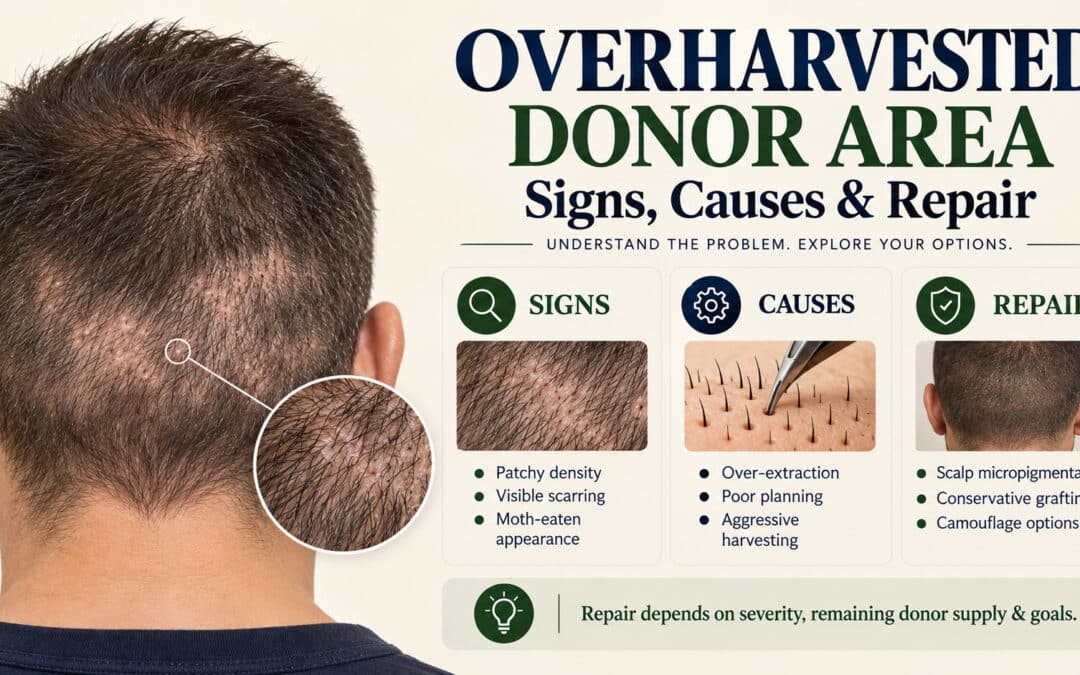
An overharvested donor area is one of the complications people worry about when considering FUE surgery, especially after seeing photos of patchy or visibly thinned donor zones. In this guide, we look at how overharvesting hair transplant donor areas happens, what the warning signs can look like, how it differs from normal recovery, and what may be possible if too many grafts have already been removed.
What is an overharvested donor area?
An overharvested donor area is a donor region that has had more follicular units removed than it can comfortably lose while still maintaining an even, natural-looking level of coverage. The result can be visible thinning, irregular density, scalp show-through, or a patchy appearance across the back or sides of the head.
During FUE, follicular units are individually removed from the donor area and transplanted to areas affected by hair loss. Once a complete follicular unit has been removed, it does not grow back in the place it was taken from. The aim is therefore not to take as many grafts as possible, but to redistribute a safe amount while leaving enough hair behind for the donor area to continue looking balanced.
This is why donor management is a major part of transplant planning. The donor area is a limited resource, and the number of grafts that can be harvested safely varies from person to person. Baseline donor density, hair caliber, hair length, hair-to-skin contrast, the size of the usable donor zone, previous procedures, and the likelihood of needing future surgery can all affect how much can reasonably be removed.
It is also important to separate permanent donor depletion from the normal appearance of the scalp soon after surgery. A freshly shaved donor area can look sparse, red, dotted, or uneven during healing. Temporary shedding can make this look more dramatic. Those early changes do not automatically mean that the donor has been permanently overharvested.
If you are trying to understand what happens to donor area after hair transplant surgery, the long-term appearance matters more than a single photograph taken during the first few days or weeks. The donor should be assessed after enough healing and regrowth have occurred to judge its true remaining density.
What causes overharvested hair transplant issues?
Overharvesting is usually associated with removing too many follicular units for the patient’s donor characteristics, concentrating extractions too heavily in particular areas, or failing to plan for the donor supply over the long term. The problem is therefore not just the total number of grafts. Where those grafts are taken from and how evenly they are removed can be just as important.
For example, two people could have the same number of grafts extracted but look very different afterward. Someone with naturally high donor density and thicker hair may retain good visual coverage after a larger session, while a person with finer hair or lower starting density could show visible thinning after fewer extractions. Hair length and the angle at which hairs leave the scalp also influence how effectively the remaining hair covers the skin.
Extraction pattern matters as well. Taking follicular units too close together can leave clusters of obvious scalp exposure. This can create a “moth-eaten” or windowed appearance, where some sections look much thinner than the surrounding donor hair. A more evenly distributed approach is designed to reduce that contrast and preserve a more uniform appearance.
That is why there is no single graft number that automatically means a donor area has been overharvested. Large sessions can increase the demands placed on the donor, but a universal cutoff ignores individual differences. A patient’s available donor supply should be measured and considered before the graft target is finalized, rather than selecting a large number first and then trying to find enough hair to meet it.
Our hair transplant graft chart can help explain why graft requirements vary by the size and location of the area being treated. However, the number needed in the recipient area still has to be balanced against the number that can be removed safely from the donor area.
Repeated procedures can also increase the risk if earlier extractions have already reduced donor density. A patient may still have visible hair across the back and sides of the scalp, but that does not mean every remaining follicular unit is available for another transplant. Long-term planning should consider what has already been taken and what reserve may be needed if native hair loss continues.
Harvesting outside the most stable donor zone is another concern. The occipital and parietal donor regions tend to show greater long-term stability in androgenetic alopecia, but the boundaries of the safer donor area are not identical for every patient. Using follicles from less stable areas can reduce the long-term reliability of the transplanted hair and may also contribute to a thinner donor appearance as hair loss progresses.
Technique also matters. FUE uses small punches and does not create the linear donor scar associated with FUT, but it is not scar-free. Each extraction creates a tiny wound that heals. If too many extraction sites are concentrated together, or if unsuitable punch size and technique are used, pinpoint scarring and reduced density can become more noticeable, particularly with very short hair.
In severe cases, poor planning and aggressive extraction may contribute to complications beyond cosmetic thinning. Published medical literature has described donor-site depletion, scarring, and, rarely, tissue injury associated with excessive or poorly executed harvesting. These possibilities are another reason donor assessment should be treated as a surgical planning issue rather than simply a graft-count exercise.
Problems associated with an overharvested hair transplant can result from several factors acting together: excessive graft demands, weak starting density, concentrated extractions, repeated harvesting, poor definition of the donor zone, and failure to account for future hair loss. When these factors are ignored, a transplant intended to improve one area of the scalp can leave another area visibly depleted.
What does an overharvested donor area look like?
A healed overharvested donor area often looks noticeably thinner or less uniform than the surrounding hair. The scalp may be easier to see through the hair, particularly under bright or overhead lighting, and the donor region may contain patches with much lower density than nearby areas.
One of the classic descriptions in medical literature is a “moth-eaten” appearance. Instead of a smooth, gradual reduction in density, the donor can look irregular, with scattered zones of thinner coverage. Some patients may have one or more obvious areas where extractions were concentrated, while others may show a more generalized loss of density across much of the donor region.
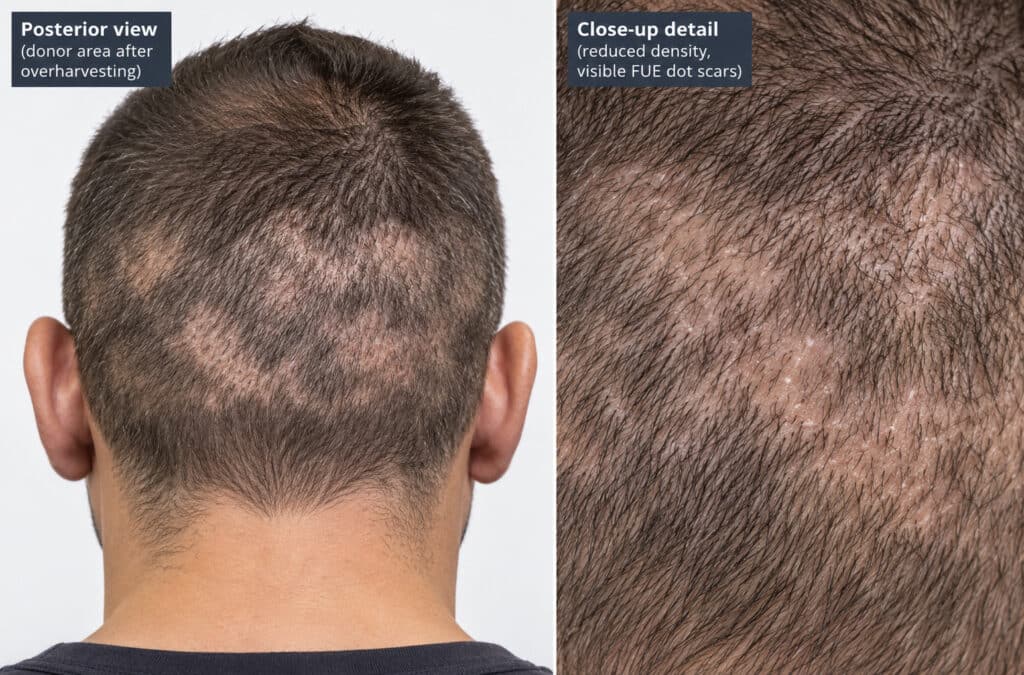
The appearance can be especially noticeable when the hair is cut short. Longer hair overlaps and provides visual coverage, while a close haircut exposes more scalp and can reveal differences in density. Small pale FUE extraction marks may also become more apparent at very short lengths, particularly when there is strong contrast between the color of the hair and the scalp.
A visible hair transplant scar does not by itself prove that a donor area has been overharvested. FUE naturally leaves many tiny extraction sites that heal individually. The concern is when scarring, reduced density, or both combine to produce an obviously depleted or uneven donor appearance after recovery.
Signs of overharvesting hair transplant donor areas
Signs that may raise concern include persistent patchy thinning, unusually high scalp visibility, obvious differences in density between neighboring parts of the donor region, and extraction patterns that remain easy to see after the hair has regrown. Some people describe distinct “windows” or sparse bands across the back or sides of the head.
However, timing matters. In the early postoperative period, the donor area may be shaved, red, tender, scabbed, or visually uneven. Surrounding hairs can also shed temporarily after the procedure. This type of shock loss can make the donor look dramatically thinner without representing permanent removal of all the hairs that appear to be missing.
For that reason, a very early postoperative photo alone is not enough to diagnose permanent overharvesting. Temporary donor shedding may improve as the affected follicles return to their normal growth cycle. Our guide, which covers donor area shock loss recovery explains how temporary postoperative shedding differs from permanent extraction of a follicular unit.
The distinction is important because extracted follicles and shocked follicles behave differently. A follicular unit that has been successfully removed for transplantation is no longer present in its original donor position. A follicle affected by temporary shock loss remains in the scalp and may produce hair again as it recovers.
Hair length can further complicate the picture. Immediately after FUE, the donor is often clipped very short. As the remaining hair grows, it begins to overlap and cover more scalp. A donor area that looked extremely exposed while shaved may therefore look considerably better several months later even though the number of remaining follicles has not changed.
Lighting, wet hair, styling products, camera flash, and the angle of a photograph can also change how dense the donor looks. When assessing a possible problem, it is more useful to compare similar photographs over time and to have the area examined directly than to rely on one image taken under harsh lighting.
Persistent irregularity after healing deserves closer assessment, particularly when the pattern follows concentrated extraction zones. A clinician can look at donor density, extraction distribution, scarring, hair caliber, and the amount of stable donor hair that remains. That assessment can help determine whether the issue is temporary, cosmetic, or a true loss of usable donor capacity.
Overharvesting can also overlap with broader concerns about a hair transplant gone wrong or a failed hair transplant, but these are not identical problems. A transplant can have poor growth or an unnatural recipient result while leaving the donor relatively well preserved. Conversely, the transplanted hair may grow while the donor area has still been depleted too aggressively.
This is why both areas should be evaluated separately. The recipient area tells you how well the transplanted grafts survived and how natural the design looks. The donor area tells you how responsibly the finite supply was managed and how much may remain available for the future.
Overharvested donor area repair options
Allow time for healing: Overharvested donor area repair begins with establishing what has actually been lost. If the donor still looks sparse because of recent surgery, temporary shock loss, short hair, or ongoing healing, the first step may simply be allowing more time before making a permanent judgment. Repair surgery performed too early could create another problem before the first procedure has fully settled.
Once a follicular unit has been completely extracted, it does not regenerate in the original donor location. That means treatment cannot simply restore every missing follicle. Instead, repair is usually about improving the visual balance of the donor area, reducing scalp show-through, camouflaging scars, or selectively adding hair where it can make the greatest cosmetic difference.
Non-surgical camouflage: The first option can be non-surgical camouflage. Growing the donor hair slightly longer may allow neighboring hairs to overlap sparse areas more effectively. A different haircut can sometimes make irregular extraction patterns considerably less obvious, especially when depletion is moderate rather than severe.
Scalp micropigmentation (SMP): SMP may also be considered in selected cases. SMP places pigment into the scalp to imitate the appearance of very short hair or reduce the contrast between visible skin and surrounding hair. It does not create new follicles or increase biological density, but it can make the donor look less transparent when the color and pattern are matched carefully.
Repair transplantation: Some patients may be candidates for a repair transplant into the depleted donor area. This requires careful planning because using more scalp donor hair from an already compromised region can worsen the shortage. The surgeon has to determine whether there are suitable follicles elsewhere that can be moved without simply creating a new thin area.
Alternative donor hair: Beard or other body hair may sometimes be considered as an alternative source for repair, depending on the patient’s characteristics and the surgeon’s assessment. These hairs can differ from scalp hair in texture, growth cycle, caliber, and appearance, so they are not interchangeable in every situation. Their use is typically selective rather than a simple replacement for depleted scalp donor hair.
Selective scalp grafting: When enough stable scalp donor hair remains, carefully redistributing a small number of grafts into the most visible depleted areas may improve blending. The goal is usually not to recreate the original density. It is to soften contrast and make the donor look more uniform without causing further damage to the remaining supply.
Medical management: If ongoing pattern hair loss is also contributing to a thinner overall appearance, separate medical management may be discussed with an appropriate clinician. This can address native hair loss, but it cannot replace follicular units that were surgically removed from the donor area.
When repair options are limited: Severe overharvesting can place real limits on what is possible. If too much of the safe donor supply has already been removed, there may not be enough suitable hair left for substantial repair or another large transplant. In those cases, conservative camouflage may provide a more realistic option than attempting aggressive additional surgery.
Long-term planning: This is also where long-term planning becomes especially important. Someone seeking repair may still be losing native hair in the recipient area. Using the remaining donor supply to improve the back of the head could reduce what is available to address future hair loss elsewhere. A repair plan therefore has to consider the entire scalp rather than treating the donor in isolation.
If you are seeking help for an over harvested donor area, a consultation should include an assessment of the original transplant history, current donor density, remaining safe donor zones, scarring, hair characteristics, recipient-area needs, and the patient’s preferred hairstyle. Those details help determine whether waiting, camouflage, SMP, selective grafting, or a combination of approaches makes the most sense.
Patients should also be cautious of anyone promising to “restore” an overharvested donor to its original biological density. Once follicular units have been permanently relocated, there is no treatment that simply puts those same follicles back. A realistic repair plan focuses on improvement, coverage, and preservation of what remains.
Key takeaways on donor area overharvesting
Donor overharvesting is not defined by one universal graft number. It happens when extraction exceeds what an individual’s donor area can tolerate visually or biologically, whether because too many grafts were removed overall, extraction was concentrated unevenly, the donor was weak to begin with, or previous procedures had already reduced the available supply.
- A well-managed donor area should retain enough density to look reasonably even after healing.
- Patchy thinning, scalp show-through, windowing, and a moth-eaten appearance can be signs of permanent donor depletion.
- Early redness, shaving, short regrowth, and shock loss can temporarily make the donor look worse than its eventual result.
- Extracted follicular units do not grow back in their original positions, so prevention is more effective than repair.
- There is no single safe graft limit for everyone. Donor density, hair caliber, extraction pattern, safe donor size, prior surgery, and future needs all matter.
- Repair may involve hairstyle changes, SMP, carefully planned transplantation, alternative donor sources, or a combination of approaches.
- Severe depletion can reduce the options available for future hair transplant surgery.
If you are concerned that your donor area has been overharvested, the most useful next step is an individual assessment after enough time has passed to distinguish normal healing from permanent density loss. The aim should be to understand what remains, protect the donor supply that is still available, and choose any repair conservatively.