
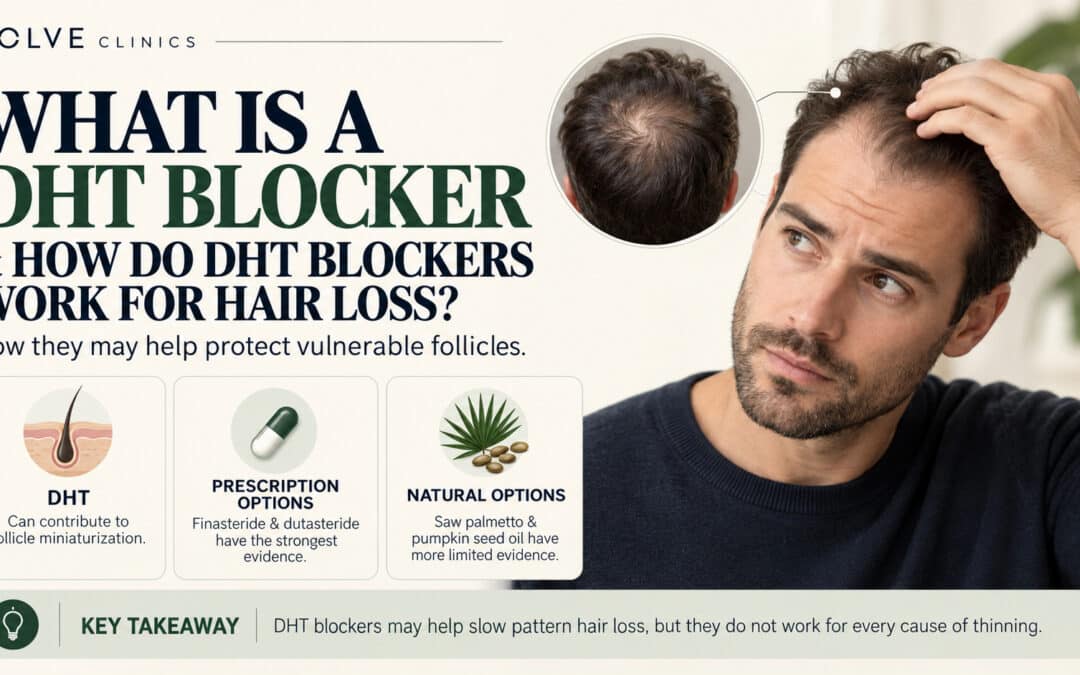
When hair starts thinning, two questions often arise: “what are DHT blockers?” and “how does DHT blocker work?” Understanding the connection between hormones and hair follicles can make treatment choices less confusing. Some options target hormone production, while others support hair growth through different mechanisms. And despite the claims on supplement labels, not every product works the same way. Here, we’ll examine the available evidence, the differences between prescription and natural options, and the results and risks worth discussing with a medical professional.
What is a DHT blocker?
Dihydrotestosterone (DHT) is an androgen made when an enzyme called 5-alpha-reductase converts testosterone into DHT. In people genetically susceptible to pattern hair loss, DHT can gradually shrink sensitive scalp follicles. Hairs become finer and grow for shorter periods, eventually making the scalp more visible. But what does DHT do in the scalp that makes some follicles vulnerable while others are unaffected? Genetics helps explain the difference.
DHT blocker meaning covers different treatments. Some medications reduce DHT production; other antiandrogens interfere with hormonal signaling. Neither treats every cause of thinning. Stress-related shedding, nutritional deficiencies, and scarring disorders require different approaches.
Do DHT blockers work for hair loss?
Yes, certain prescription DHT blockers can slow androgenetic alopecia, also called male or female pattern hair loss. Some people also regain hair density, especially when treatment begins before follicles have become severely miniaturized. Results vary, and stopping an effective medication generally allows hereditary thinning to resume. A clinician should confirm the diagnosis before recommending treatment, because lowering DHT will not resolve every form of hair loss.
A receding hairline, thinning crown, or widening part may suggest androgenetic alopecia. A dermatologist can review family history and other possible causes before recommending treatment.
How do DHT blockers work?
Finasteride inhibits the type II form of 5-alpha-reductase, reducing the conversion of testosterone into DHT. Dutasteride inhibits types I and II, typically suppressing DHT more extensively. The difference between finasteride and dutasteride matters when weighing potential benefits against risks. But does finasteride work for everyone? Not necessarily. Results depend on the diagnosis, treatment consistency, and individual biology.
Not every effective hair-loss treatment affects this pathway. For instance, does minoxidil block DHT? No, but minoxidil can support hair growth without acting as a 5-alpha-reductase inhibitor. This distinction explains why clinicians sometimes use treatments with different mechanisms together.
DHT blocker benefits
For appropriately selected patients, benefits may include slower shedding from pattern hair loss, better preservation of existing density, and some regrowth. Treatment is usually most useful before extensive thinning develops. It does not reliably restore follicles that can no longer produce hair, nor does it guarantee a full hairline. Some people do well with finasteride without minoxidil, while others need a different or combined approach.
Explore SolveRX Hair Regrowth Treatments
How to lower DHT
Options for how to block DHT production depend on whether hair loss is actually DHT-related. Shedding alone does not prove that DHT is the cause or that lowering it is appropriate. Anyone concerned about DHT-related thinning should first establish the diagnosis and discuss medical history, pregnancy considerations, and treatment goals with a qualified professional. Prescription medicines and natural products have very different levels of supporting evidence.
Use prescription DHT blocker products
A DHT blocker prescription may involve oral finasteride, which is FDA-approved for male pattern hair loss in the United States. Dutasteride also inhibits 5-alpha-reductase, but its use for hair loss is off-label in the US. But does dutasteride regrow hair, or does it mainly preserve existing hair? Studies suggest some patients experience both reduced loss and regrowth, but individual outcomes are not predictable.
For those exploring topical treatment options, SolveRx offers topical dutasteride online in a formula combined with minoxidil, subject to medical review.
Treatment differs for women. Spironolactone is sometimes prescribed off-label as an antiandrogen for female pattern hair loss; it acts mainly by opposing androgen effects rather than functioning like finasteride. Our discussion of spironolactone for hair loss in females covers that distinction. Finasteride, dutasteride, and spironolactone should be avoided during pregnancy. Patients who could conceive need appropriate pregnancy-prevention advice.
DHT blocker side effects depend on the medicine. Finasteride and dutasteride can cause sexual symptoms and breast tenderness; some sexual effects have been reported after treatment stops. Finasteride can also cause mood changes, including depression and suicidal thoughts. Spironolactone has different risks, including low blood pressure and high potassium. Tell your prescriber about mood changes, other medications, and any prostate-specific antigen (PSA) testing, as these DHT-reducing drugs can affect PSA results. Seek medical advice before starting or stopping treatment.
Try natural products to block DHT production
Saw palmetto is marketed as a plant-based DHT reducer. Small studies of particular extracts have reported improvements in hair measures, and some have investigated hormone changes. However, findings are inconsistent, products vary substantially, and clinical evidence remains too limited to establish reliable effectiveness for pattern hair loss. Evidence of modest hair growth is not necessarily proof of meaningful DHT suppression in scalp follicles.
There is also interest in pumpkin seed oil for hair growth. A 24-week trial of 76 men tested branded pumpkin seed oil capsules and reported improved hair counts. It did not measure DHT or establish that lowering DHT caused the result, and the finding cannot automatically be applied to ordinary pumpkin seed oil. Laboratory findings about 5-alpha-reductase should not be presented as proof of the same effect in humans.
Other popular ingredients have weaker evidence. For example, does biotin block DHT? There is no convincing human evidence that it does, although treating a genuine biotin deficiency may help deficiency-related hair problems. High-dose biotin can also interfere with some laboratory tests. Claims that a product is the best DHT blocker supplement should therefore be treated cautiously. Supplements can cause adverse effects or interact with medication; natural does not automatically mean effective or safe.
Laboratory results do not prove DHT-blocking shampoos reach scalp follicles effectively.
What DHT blocker should you use?
The most effective DHT blocker for one patient may be unsuitable for another. Diagnosis, sex, pregnancy potential, medical conditions, side-effect tolerance, and treatment goals all matter. For men with pattern hair loss, finasteride has stronger clinical evidence than herbal supplements. For women, a clinician may discuss other approaches; the best DHT blocker for women depends on circumstances rather than one universally superior product.
In short, DHT-targeted treatment can help protect vulnerable follicles, but it is not a cure for every kind of hair loss. Seek an individualized assessment rather than relying on supplement claims or attempting to suppress hormones without medical advice. Meaningful changes take months, and the goal is often preserving hair as much as regrowing it.
Find Your Hair Loss Treatment at SolveRX
FAQs
Does DHT blocker help hair growth?
A proven prescription DHT blocker may help some people with pattern hair loss retain existing strands and regrow some thinner hairs. Results depend on how much follicle activity remains and how consistently treatment is used. It cannot reliably restore hair in every bald area or treat unrelated conditions.
How long does it take for DHT blockers to work?
Hair changes are gradual, even when a medicine lowers DHT much sooner. Some people notice improvement after several months, but clinicians commonly assess results over six to twelve months. Progress photographs can help track subtle changes. Continuing effective treatment is generally necessary to maintain its benefits.
Do natural DHT blockers work?
Some natural ingredients, particularly saw palmetto and pumpkin seed oil, have produced encouraging findings in small studies. However, the evidence is not strong enough to confirm dependable DHT reduction or consistent hair regrowth. They should not be viewed as proven substitutes for prescription treatments, and supplements still carry risks.
Can DHT blockers reverse hair loss?
DHT blockers can sometimes partially reverse follicle miniaturization associated with pattern hair loss, leading to thicker hairs or improved coverage. Complete reversal is unlikely, especially after advanced or prolonged thinning. They also cannot reverse every cause of shedding. Early diagnosis provides a better opportunity to preserve remaining hair.
Resources
- American Academy of Dermatology: Male pattern hair loss treatments
- American Academy of Dermatology: Female pattern hair loss
- NIH NCCIH: Saw palmetto research and safety
- Randomized clinical trial of pumpkin seed oil and hair growth
- FDA: Propecia prescribing information
- DailyMed: Dutasteride prescribing information
- European Medicines Agency: Finasteride safety review
- NIH: Biotin research & laboratory testing