
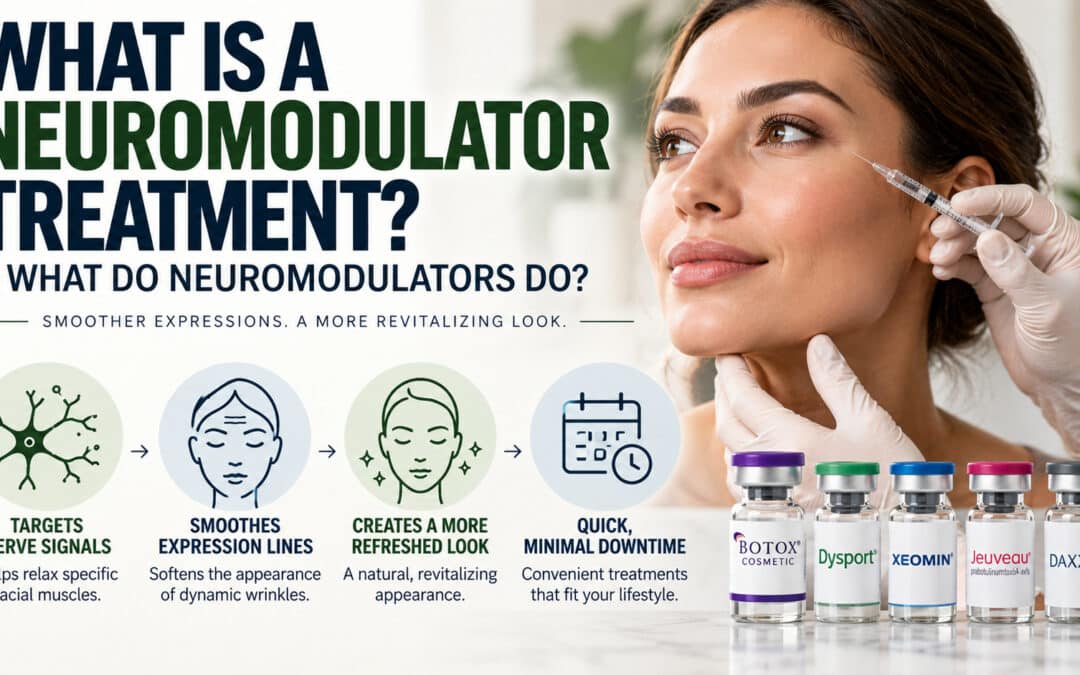
What is a neuromodulator, and what do neuromodulators do exactly? If you are exploring a revitalizing treatment approach, you may be wondering how this category differs from other injectable options. Below, we break down how neuromodulators work, the products available, the concerns they can address, and what you can expect from a consultation at Solve Clinics.
What is a neuromodulator?
So, what are neuromodulators in cosmetic medicine? They are injectable treatments that temporarily change the way selected nerves communicate with specific muscles. In aesthetics, this usually means reducing muscle activity in carefully chosen areas, which can soften expression lines or alter how certain facial features move without adding volume.
Neuromodulators are commonly associated with botulinum toxin products used in cosmetic medicine. Although the brand names, formulations, dosing systems, and treatment characteristics can differ, they work through the same general principle of temporarily limiting the nerve signals that tell targeted muscles to contract as strongly.
This is different from dermal fillers, which are used to add or restore volume. Neuromodulators work on muscle activity instead. That distinction is important because the right treatment depends on what is creating the concern, whether that is repeated movement, facial structure, volume loss, or another factor.
Understanding the Types of Neuromodulators used in aesthetic medicine can make the available options easier to compare. The most appropriate choice can depend on your goals, treatment area, previous experience, and provider recommendation. A consultation allows the injector to assess facial movement and discuss which approach may suit you.
What do neuromodulators do?
Neuromodulators work by temporarily reducing communication between a nerve and the muscle it controls. When a targeted muscle contracts less strongly, the skin above it is folded less aggressively during facial expression. Over time, this can make dynamic lines look softer while the treatment remains active.
Treatment is intended to reduce activity in selected muscles, so placement and dose matter. Injectors assess how your facial muscles work together before choosing injection points. The aim is generally not to stop all movement, but to reduce specific movements enough to achieve the intended cosmetic result.
Results are not permanent. The effect gradually wears off as nerve-to-muscle communication returns, and muscle activity increases again. How long a treatment lasts varies between people and can also differ by product, treatment area, dose, metabolism, and how strongly the targeted muscles are normally used.
Because neuromodulators affect movement rather than replacing lost volume, they are often used for expression-related concerns. They may also be used strategically in areas where reducing the pull of a particular muscle can change appearance, such as the lip, jawline, or brow, depending on individual anatomy.
Common neuromodulator treatment options
Botox:
Botox Cosmetic is one of the best-known neuromodulator brands and is used at Solve for a range of aesthetic concerns. If you want to explore treatment locally, our Chicago Botox services page explains the consultation process, common treatment areas, expected timing, and what to consider before booking.
Botox is often used where repeated muscle movement contributes to visible expression lines, but the exact injection pattern is individualized. It is also used off-label for selected lower-face and jaw concerns. Your provider will consider muscle strength, facial balance, and your desired degree of movement before treatment.
Dysport:
Dysport is another botulinum toxin type A neuromodulator used to temporarily reduce targeted muscle activity. People comparing Dysport vs Botox will find that the products have different formulations and dosing units, so unit numbers should not be treated as directly interchangeable between the two products.
The practical choice between Dysport and another neuromodulator may depend on the treatment area, injector preference, previous results, and individual goals. Rather than choosing by brand name alone, it is generally more useful to discuss the result you want and let your provider recommend an appropriate option.
Xeomin:
Xeomin is a botulinum toxin type A injectable used for cosmetic neuromodulation. When considering Botox vs Xeomin, the important point is that both temporarily reduce targeted muscle activity, while their formulations differ. The amount used and injection pattern are selected according to the product and treatment plan.
Some patients become interested in Xeomin after previously using another neuromodulator, while others simply want to understand the available choices before their first treatment. A consultation is the best place to compare realistic outcomes, treatment areas, expected duration, and whether switching products would provide any meaningful advantage.
Daxxify:
Daxxify is another injectable neuromodulator option used to reduce targeted muscle movement. Discussions about Botox vs Daxxify often focus on formulation and treatment duration, but individual results vary. The best choice should be based on the area being treated, your goals, and your provider’s clinical recommendation.
Because different neuromodulators are not dosed identically, comparisons based purely on the number of units can be misleading. Your injector should determine an appropriate dose for the specific product being used, the strength of the target muscles, and the amount of movement you want to preserve after treatment.
Jeuveau:
Jeuveau is a botulinum toxin type A neuromodulator developed for aesthetic use. If you are comparing Botox vs Jeuveau, both are designed to temporarily reduce targeted muscle activity. Differences in formulation and dosing mean the treatment plan should be based on the individual product rather than direct unit-for-unit comparisons.
As with other neuromodulators, the experience and outcome depend heavily on where the product is placed and how much is used. Facial anatomy, muscle strength, symmetry, and personal preferences all matter, which is why a tailored assessment is more useful than assuming one brand is automatically best for everyone.
What are neuromodulators used for at Solve Clinics?
Lip flip:
A lip flip uses small, off-label neuromodulator injections around the upper lip to relax selected muscles and allow more of the lip to show when smiling. It does not add filler volume. Our Lip Flip Chicago services page explains how the treatment works and who may be a suitable candidate.
This approach can suit someone who wants a subtle change in upper-lip appearance rather than added volume. Because the muscles around the mouth are important for speaking, drinking, and expression, conservative dosing and careful placement are especially important when a neuromodulator is used in this area.
Masseter reduction:
Neuromodulators can also be used off-label in the masseter muscles at the sides of the jaw. Reducing activity in these strong chewing muscles can gradually create a slimmer lower-face appearance in suitable patients. See our masseter reduction Chicago services page for more detail about assessment, treatment, and expected changes.
Masseter treatment is not the same as removing fat or adding filler, and changes develop as the treated muscles become less active over time. The effect can vary depending on muscle size and facial structure, so an assessment helps determine whether prominent masseters are actually contributing to the concern.
TMJ Botox:
Botulinum toxin is used off-label for some muscle-related temporomandibular disorder symptoms. Evidence is mixed, and it is not an FDA-approved treatment for TMD. Our TMJ Botox Chicago services page covers the approach in more detail. Suitability depends on the cause of symptoms, and not every jaw pain problem is muscular.
Neuromodulators for men:
Neuromodulator treatment is not limited by gender, and the underlying approach is similar for men and women. Botox for Men Chicago treatments may be planned differently because muscle strength, facial proportions, and cosmetic goals vary between individuals. The objective should remain a result tailored to the person’s preferences.
Excessive sweating:
Botulinum toxin can also reduce sweating by blocking nerve signals that activate sweat glands. Botox is FDA-approved for severe primary underarm hyperhidrosis in certain adults when topical treatments do not work well enough. Botox for hyperhidrosis in other areas may be off-label, so suitability should be discussed during consultation.
Jawline contouring:
In the lower face, off-label neuromodulator treatment may contribute to a more defined appearance when muscle activity is affecting facial shape. Our jawline contouring Chicago services page covers available approaches. Some patients may need a different treatment, or a combination approach, depending on their underlying anatomy.
Facial balancing:
Facial balance sometimes involves considering how multiple features interact rather than treating one wrinkle or area in isolation. Neuromodulators can be one part of this approach when muscle activity affects symmetry or proportion. Our facial balancing Chicago services page explains how treatment planning can consider the face as a whole.
Dynamic expression lines:
Neuromodulators are frequently used for dynamic lines created by repeated facial expressions, including areas of the forehead, between the brows, and around the eyes. Whether treatment is appropriate depends on how the lines form, the amount of movement present, and the balance between softening lines and preserving expression.
Other targeted facial areas:
They can also be used in carefully selected areas to influence the pull of facial muscles, such as around the brows, mouth, chin, or neck. These applications require precise assessment because nearby muscles may perform different functions, and small changes in placement or dose can affect the final result.
Interested in finding out which option may suit you? Pop in and see us to discuss your goals, or contact us to arrange a consultation. Our Chicago med spa team can assess your facial movement, explain suitable treatments, and build a plan around the result you want.