
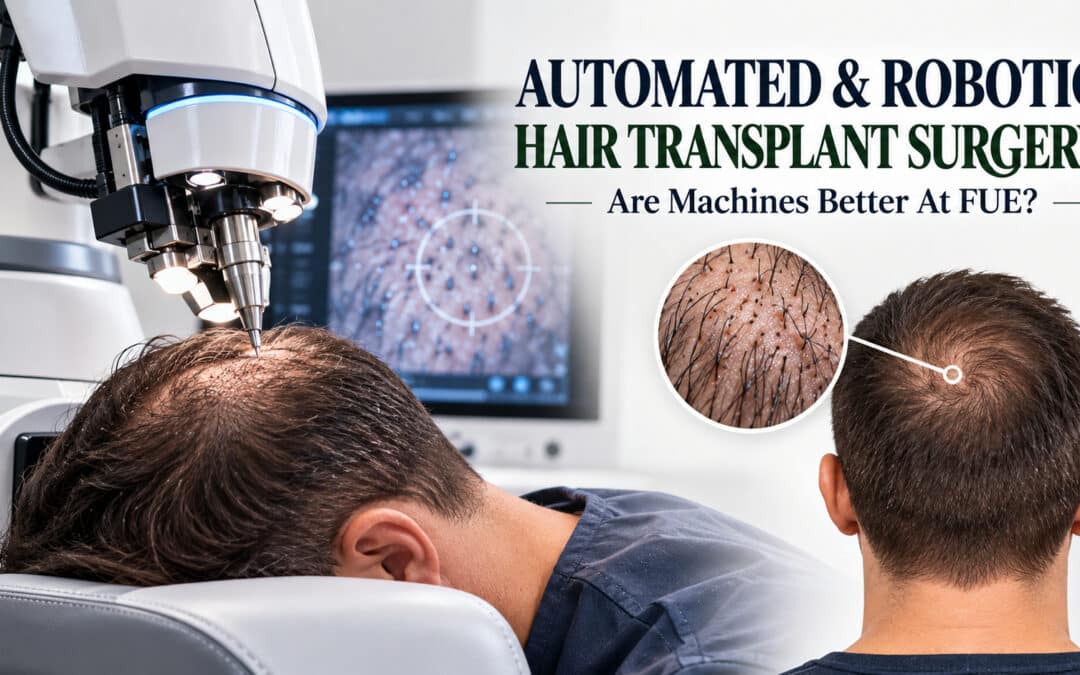
The prospect of a robotic hair transplant raises some understandable questions. Can a machine harvest hair more accurately than a clinician? Does an automated hair transplant remove the need for a surgeon, or simply give the surgical team another tool? The terminology can make these technologies sound more similar than they really are. In this article, we examine how robotic systems and automated devices work, what they actually contribute to a procedure, and what patients should consider before deciding whether either approach is right for them.
What is a robotic hair transplant system?
A robotic hair transplant system uses computer-guided imaging and mechanical components to assist with specific steps in hair restoration surgery. Rather than functioning as an independent surgeon, it operates within a clinical workflow planned and supervised by trained professionals. The most familiar example is ARTAS, a system developed for robot-assisted follicular unit excision (FUE).
During FUE, individual follicular units are removed from a donor area, typically at the back or sides of the scalp, and subsequently placed where additional coverage is wanted. An Artas robotic hair transplant uses image-guided technology and a robotic arm to identify and assist with harvesting suitable units. It is still FUE surgery, not a completely different way of growing hair.
Importantly, the features available depend on the generation and configuration of the equipment. Earlier ARTAS workflows centered on robotic harvesting, with some systems also assisting with recipient-site creation. According to manufacturer documentation on ARTAS and ARTAS iX, an ARTAS iX system equipped with its implantation feature can also assist in placing harvested grafts.
That distinction matters when reading descriptions of robotic hair transplantation. One clinic may use the robot for harvesting but place grafts manually, while another may have an ARTAS iX configuration with additional functionality. The word “robotic” alone does not tell you exactly which steps a machine performs during an individual procedure.
A robotic hair restoration system can offer repeatable movements and consistent image analysis, particularly when processing large numbers of follicles. However, the surgeon remains responsible for assessing suitability, overseeing the operation and planning the overall restoration. A patient should be able to ask which tasks are robot-assisted and who performs everything else.
What is an automated hair transplant system?
An automated hair transplant system generally refers to a powered device that helps a clinician carry out part of an FUE procedure. Unlike a true surgical robot, these tools usually depend on a handpiece positioned and directed by a person. “Automated” might describe a motor-driven punch, suction-assisted graft collection or another feature of the equipment.
NeoGraft is one example. Its powered handpieces and suction-assisted technology support follicular extraction, and some configurations offer tools for recipient-site creation or reimplantation. SmartGraft is another motorized, suction-assisted FUE device, with a system designed to collect and store harvested grafts under controlled conditions before they are implanted. Neither should be described as a self-operating hair transplant robot.
The distinction is especially useful when reviewing different hair transplant methods. FUE describes how grafts are harvested. The terms robotic and automated generally explain what equipment assists with that work. A clinic might use a manually controlled punch, a motorized handheld device or a robotic platform while still performing an FUE-based transplant.
A motorized handpiece may make repetitive movements easier for the operator, but it does not make decisions about how many grafts to take, where to take them from or how to create a believable hairline. Those choices require patient-specific assessment. Equally, the presence of a sophisticated device does not automatically establish that a procedure will be quicker, safer or more successful.
If a clinic describes its equipment as a “robot,” ask whether it has an image-guided robotic arm or whether the surgeon simply operates a powered extraction device. Both types of technology may be useful, but they are not interchangeable descriptions, and the difference deserves more than a marketing label.
How robotic follicular unit extraction works
People often ask us, how do they do hair transplants when a robot is involved? The underlying stages remain similar to other FUE procedures: assess the donor supply, remove individual follicular units, protect the grafts and place them into the treatment area. What changes is the assistance provided by the machine.
- Consultation and planning. The clinician examines hair-loss patterns, donor density, hair characteristics and the areas needing coverage. A treatment plan establishes a realistic graft requirement and how the available donor hair should be used. The robotic system does not independently decide the patient’s goals or suitability for surgery.
- Donor-area preparation. The team prepares the scalp, provides the appropriate anesthesia and positions the patient for access to the donor zone. Many robotic workflows require particular hair length and positioning so that the vision system can identify follicles. Suitability and preparation requirements depend on the device being used.
- Imaging and follicle selection. The system analyzes visible follicular features such as orientation and spacing. Its software assists with identifying potential targets and planning a harvesting pattern. A surgeon must still consider the longer-term donor supply and adjust the approach if the patient’s anatomy or hair characteristics call for it.
- Robot-assisted graft harvesting. The robotic arm guides a punch to make small circular incisions around selected follicular units. Depending on the setup, the device assists with the harvesting step, while qualified medical professionals remain responsible for carrying out the surgery and handling the grafts. An FUE robotic hair transplant does not mean that harvested follicles automatically arrive in their final positions.
- Graft care and recipient planning. Harvested units must be protected while the team determines where to place them. Hairline shape, direction, spacing and the distribution of single- and multi-hair grafts affect the final appearance. Some robotic configurations assist with recipient-site creation; other workflows depend on clinician-created sites and manual graft placement.
- Implantation and aftercare. The harvested follicles are placed into the recipient area according to the treatment plan. On appropriately equipped ARTAS iX systems, robotic assistance can extend to implantation, but other systems and workflows use clinician-operated placement tools. Medical supervision, postoperative instructions and follow-up remain essential either way.
A robot hair transplant is still a surgical procedure involving small scalp incisions. FUE avoids the long linear donor scar associated with strip harvesting, but it does not mean the scalp is left without any marks or risk of visible scarring. The International Society of Hair Restoration Surgery (ISHRS) also cautions against treating device branding as a replacement for clear surgical terminology.
Different generations of robotic equipment can therefore produce different answers to the question of what the machine does. Before accepting claims about completely automated surgery, ask the clinic for its exact device model, which stages it assists with and who is responsible for the remaining clinical work.
A note on robotic DHI vs FUE
When people discuss FUE vs DHI hair transplant procedures, they often treat them as competing options. In fact, the terms describe different stages of a transplant. FUE, or follicular unit excision, describes harvesting individual follicular units from the donor area. DHI, or direct hair implantation, commonly refers to placing those harvested grafts using an implanter pen.
A clinician-operated sharp implanter can create a small recipient opening and insert a graft in one movement. That is an implantation technique, not a separate way to extract hair. A DHI procedure can therefore use grafts harvested through FUE, whether the harvesting itself was performed with manual, motorized or appropriate robotic assistance.
Conventional DHI pens are operated by clinicians; they are not inherently robotic. The question of robotic DHI vs FUE is consequently not a like-for-like comparison. One term concerns an approach to implantation, while the other is usually used for the technology assisting FUE extraction. Recipient-site creation is another distinct step that should be described clearly.
You may also see a clinic advertise a robotic DHI hair transplant. That is not a universally standardized surgical category. It may describe a proprietary system or a clinic’s terminology for combining technologies. Rather than assume the claim is either meaningless or proof that every stage is robotic, ask precisely how the follicles are harvested, how the recipient sites are created and how grafts are implanted.
ARTAS iX adds another reason to be precise: versions equipped with its implantation feature can assist with both recipient-site creation and graft placement. That does not make all ARTAS treatments “DHI,” nor does it mean that a conventional DHI implanter pen is a robot. The safest comparison identifies the technology used at each stage rather than assuming one branded label promises better results.
How an automated hair transplant machine works
An automated hair transplant machine assists with repeated tasks while a clinician continues to guide the procedure. In a typical motorized FUE workflow, the team assesses the donor area, numbs the scalp and selects an appropriate punch and extraction strategy. A motor then turns or oscillates the punch while the operator positions it around individual follicular units.
With devices such as NeoGraft, suction may help collect follicles after the punch has separated the surrounding tissue. SmartGraft also uses a powered extraction handpiece and a collection system designed to keep grafts moist and at a controlled temperature while they await implantation. These are device-specific capabilities, not evidence that an entire transplant runs automatically.
The clinician must still judge follicle angle, depth, spacing and the amount of donor hair that can safely be removed. Incorrect technique can damage grafts or produce an uneven-looking donor area, regardless of whether a punch is motorized. Careful selection, handling and storage remain important after each follicular unit has been extracted.
Once the grafts are ready, an appropriately qualified professional creates recipient sites, and follicles are implanted using forceps or an implanter according to the treatment plan and applicable medical regulations. Some automated systems include implantation aids, but this does not remove the need to plan graft direction, density and distribution. The result depends on the whole operation, not simply the harvesting handpiece.
It’s worth being skeptical of advertising that implies the latest hair transplant technology performs every task better by default. A well-trained medical team using familiar equipment may achieve good outcomes, while a device in inexperienced hands does not provide an automatic safeguard against poor decisions.
How much of a robotic FUE hair transplant does the robot actually do?
There is no single answer for every robotic FUE hair transplant. On an earlier ARTAS setup, robotic assistance might be concentrated on identifying and harvesting follicles, with the team preparing the recipient sites and placing grafts. ARTAS iX expanded the potential workflow to include robotic recipient-site creation and implantation on suitably equipped systems.
Even when the hardware can assist with multiple stages, the operation does not become surgeon-free. A robot needs a suitable patient, a clinical plan, correctly prepared equipment and human oversight. The surgeon and medical team also need to respond when real-world conditions differ from those anticipated during planning. The ISHRS guidance on scalp surgery treats FUE incisions and recipient-site creation as surgical work, even when a robot assists, and emphasizes appropriately licensed medical oversight.
- Tasks the robot may assist with: mapping and analyzing follicles, identifying extraction targets, guiding punch movements, creating recipient sites and, on certain ARTAS iX configurations, placing grafts.
- Tasks that still need clinical judgment: diagnosing the reason for hair loss, assessing donor supply, determining candidacy, designing the hairline, deciding graft distribution and evaluating medical risks.
- Tasks that still need a qualified team: anesthesia, patient preparation, monitoring, equipment oversight, graft care where applicable, aftercare instructions and follow-up assessments.
The manufacturer describes advanced imaging, automated movements and greater consistency, but those engineering features should not be confused with a guarantee of superior graft survival or a more natural result for every patient. Some patients may not fit a particular system’s indicated hair characteristics or workflow, and suitability should be checked rather than assumed.
For example, the manufacturer’s U.S. ARTAS information identifies specific indications relating to male-pattern hair loss and black or brown straight hair. Patients with hair that falls outside those indications should ask what is appropriate for them rather than assume all robotic hair restoration equipment can accommodate every hair type equally.
So, could a hair transplant robot carry out some of the technically demanding stages? Yes. But when a clinic promotes the idea of a completely hands-off procedure, it is reasonable to ask who makes the surgical decisions, who is present and which portions actually use robotic assistance.
Marketing often presents robotic hair transplants as a single category, but different device models and clinical protocols can shape the patient’s actual experience. Ask about the precise workflow rather than relying on broad claims about robotic hair transplant surgery.
How much does a robotic hair transplant cost?
Robotic hair transplant cost varies with the number of grafts, clinic location, surgeon experience and which services the quoted fee includes. Equipment costs can also influence pricing. Clinics may charge a flat treatment fee or calculate costs per graft, so two advertised prices may not cover the same amount of work.
There is no verified, representative U.S. national average specifically for robotic FUE that we can confidently quote. For context, hair restoration surgeon Glenn Charles gives a published 2026 estimate of approximately $7,000 to $18,000 or more for ARTAS procedures in his comparison of robotic and clinician-performed FUE. This is one clinician’s published estimate, not a national survey or a quote from Solve Clinics.
For another point of reference, one surgeon’s published comparison gives illustrative costs of approximately $12 to $14 per graft for ARTAS and $4 to $7 per graft for clinician-performed FUE. These are published estimates, not national averages or matched patient quotes. They should not be used to predict the price of any individual procedure.
For the fairest comparison, request written quotes based on a similar graft count and ask whether they include consultation, anesthesia, harvesting, implantation, follow-up and any additional fees. Also ask who performs each surgical stage. Paying more for a machine does not, by itself, establish that a transplant will look better or last longer.
Should you choose a robotic hair restoration machine? Our conclusion
Robotic and automated systems have legitimate uses in modern hair restoration. They can support repetitive technical work, and certain robotic platforms extend beyond harvesting to recipient-site creation and graft implantation. However, choosing the best treatment isn’t as simple as finding the clinic with the most sophisticated equipment.
If you’re researching robotic hair transplant vs manual options, focus on the proposed clinical plan rather than the marketing category. Ask how your donor area will be managed, who will design and create the hairline, how grafts will be handled and what results are realistic for your pattern of hair loss.
At Solve Clinics, we perform FUE without robotic systems. We prefer an individualized, clinician-performed approach in which the team can adapt harvesting and placement decisions to the patient’s hair, donor supply and restoration goals. This reflects our clinical approach, not a claim that robotic procedures are inherently ineffective or always inferior.
A 2024 comparative study of 13 men found no statistically significant difference in follicular yield, transection rate or patient satisfaction between ARTAS and conventional FUE. The ARTAS-treated areas had a higher graft discard rate. The study was small and does not establish that either method is superior for every patient.
Is a robot for hair transplant surgery worth considering? For some suitable patients, technology-assisted workflows may make sense. The important question is whether the surgeon’s experience, the equipment and the treatment plan are appropriate for you. Here is a balanced look at the principal trade-offs of ARTAS specifically.
Artas hair transplant advantages
- Image-guided follicle assessment can support consistent targeting and repeatable punch movements.
- Robotic assistance may reduce some repetitive demands on the surgical team during graft harvesting.
- On appropriately equipped ARTAS iX systems, assistance can extend to recipient-site creation and implantation.
Artas hair transplant disadvantages
- Device indications and patient-specific factors may limit suitability for certain hair characteristics or restoration plans.
- Equipment and operating costs may increase treatment prices without guaranteeing a better result.
- The surgeon’s planning, judgment and oversight remain essential; a robot cannot independently ensure a natural looking hair transplant.
At Solve, our priorities are careful donor management, a hairline designed for the individual and graft placement that follows the patient’s natural growth patterns. For us, good planning and skilled clinical execution matter more than whether a machine carries out part of the work.
If you’re considering a hair transplant and want to know whether clinician-performed FUE suits your needs, book a free consultation with Solve Clinics. We can discuss your hair-loss pattern, donor availability, likely graft requirements and realistic results, without suggesting that any particular tool can guarantee an outcome.